The table has been updated again. Now with almost all the CPUs. The Kohjinsha SH6 processor A100 has the same score than my old eo v7110 where I had installed Vista for a while with a 7200 RPM HDD and 1 GB of RAM. Intel's graphic chip is a lot better and it use 256 MB of RAM so that explains why Vista performs better in the SH6 than in my eo v7110 with only 64MB of Video Shared Memory. These numbers have given me another dimension to compare all the machines in the market. 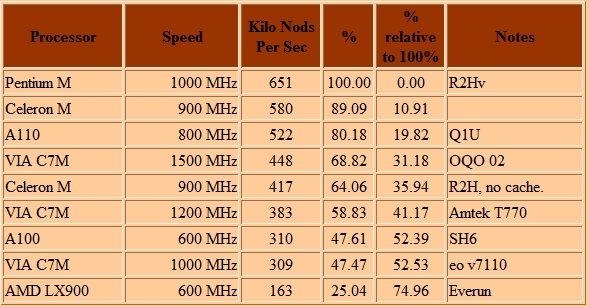
Will I buy an UMPC just using these numbers? Of course no. Choosing an UMPC is like a complex equation with many variables. But definitely the CPU and the Chipset play an important role in my equation. And I said my equation because in somebody's else equation probably battery life is more important or just the external design.
Tuesday, August 21, 2007
CPU Benchmark table updated once again


More info about CPU Benchmarks
I keep updating the Fritz Chess Benchmark table. Today I added the information for the Intel Celeron 900 MHz without cache used in the Asus R2H first generation. Probably many of you have read me saying that the R2H was the slowest machine using an Intel Processor from the first generation, well, this has been confirmed again with this test.
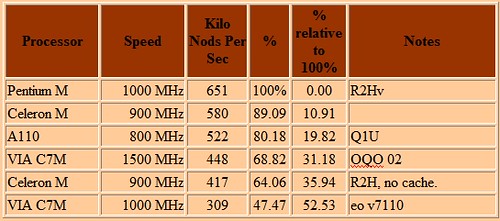
As you can see, the Intel Celeron without cache score slower than the A110 and VIA C7M. I'm still waiting for the results of this test that Chippy promised to send me, the AMD should score close to the VIA used in the eo v7110, I believe.
Monday, August 20, 2007
CPU Benchmark tests updated
I received the results of Fritz Chess Benchmark for the OQO 02 at 1500 MHz. The result is 25.33 less than the result of the same test in a Pentium M but it's close to 25% higher than what we saw in the eo v7110. Now we can say for sure that the OQO 02 is slower than UMPC using Pentium M, Celeron M and the A110.
I created a new table in my benchmark page with all these results.
Friday, August 17, 2007
How fast is your processor?
Recently I have been involved in a series of discussions about performance and processors speed. And in all these discussions people use words like "slightly slower", "a little bit slower", "not that slow", but up to this moment I have not seen anybody presenting a real number, a result of a real test.
There are many benchmark programs and all of them include Processors tests but sometime they are hard to read and harder to compare the results. So I started to think about an easy way to show exactly how slow is a processor compared to another and I remembered then about a Chess program that I used back in the 80s: Fritz. That program has a benchmark option to measure how many positions a processor can calculate per second. This test only measure that and it does not depend on the memory installed or any other hardware parameter. Then somebody pointed me to this program which does that and only that, it checks how many chess positions per second any processor can calculate.
I ran the program in my both UMPCs, the eo v7110 and the Q1 Celeron and I asked a group of people to run it in Q1Us (A110) and a eo i7210 (Pentium M). I gathered all the reports and selected the best results in each case. I have to say at this point that all the results for a single device were very close one to another. And that's normal because the only thing that could may this test to have different results is the processor being used while the test was running. This means that for a higher score you had to be sure that there was not any program using the processor at that time. That's all.
So here are the screen shots of the results that I have selected.
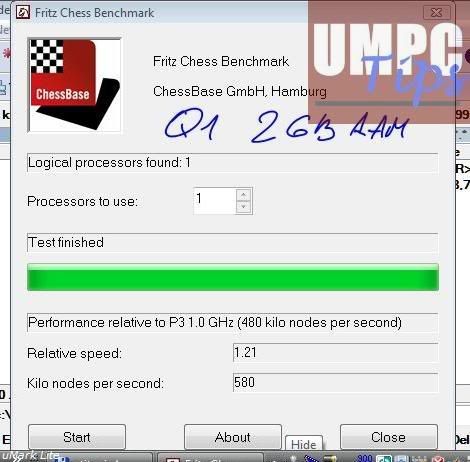
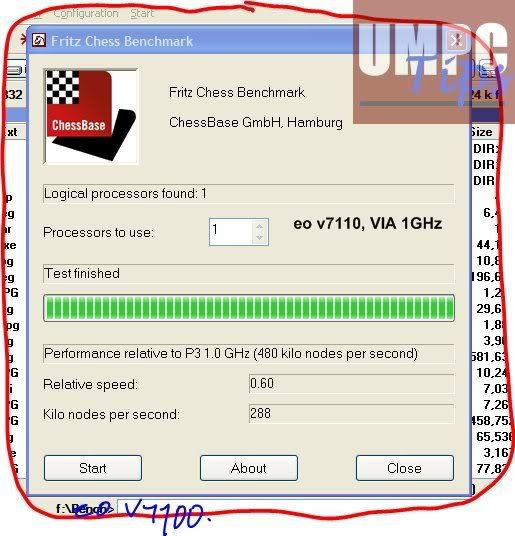
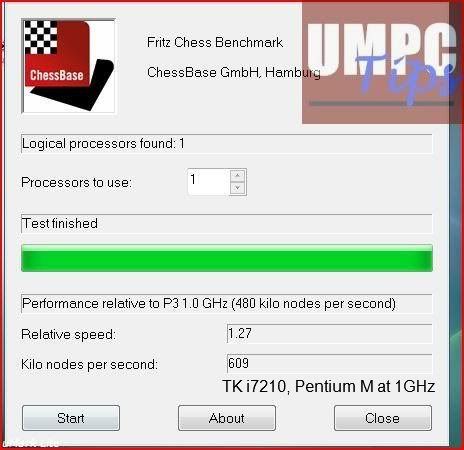
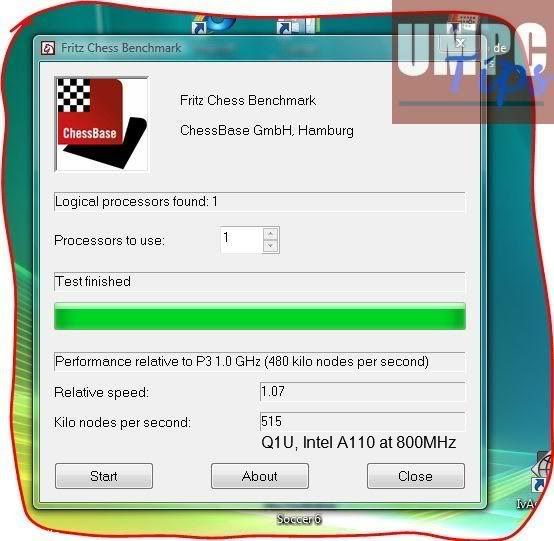
I have prepared a little table with these results and some calculations.
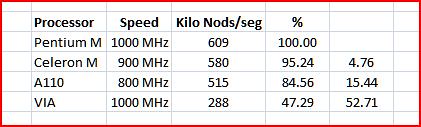
The column in the right shows how slow is any Processor compared to a Pentium M running at 1000 MHz used in the first generation of UMPCs.
This could be not the best way to test how good is a processor but at least is one of the simplest one I have found. If you know of any other method I'll be glad to test it and gather again all this information just to have real numbers to compare each processor.
Thursday, May 31, 2007
VIA vs Intel
Here is how I got into the word Crappy. Few weeks ago I posted a poll in this site and more than 70 people voted.
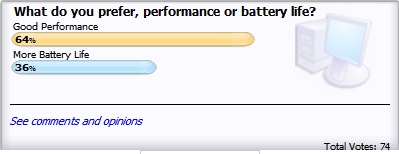
64% of them voted for a better performance. That's the group where I'm, 36% voted for better battery life, that's where my brother Steve is.
In the way I see current UMPC market, we have in the latest generation UMPCs using the A110 and A100 Intel processors, we have UMPCs using the latest C7 from VIA and we have if we still have any, Steve can correct me because he is keeping a wonderful table with all UMPCs in the market, a very small group using AMD processors. If you check, it seems to me that in this second round there are more UMPC using the VIA C7 processor than in the first round. And I believe that Intel felt this pressure. And what happened, using Chippy's words, Intel "optimized" a Pentium M processor, locking the speed at 600 or 800 MHz, decreasing the cache size, and including some minor "new" features. Using my own words, it took a C7 processor, checked the performance of it and configured the Pentium M to match that performance. The result, a processor with almost the same performance and battery life.
And what was the cost? Well for 64% of the UMPC owners that means less performance, for 36% means more battery life.
What I was expecting from Intel, well I was expecting a processor with the same performance we had in the Pentium M and Celeron M processors used in the first generation at least and with the same battery life we see in current VIA processors. That would be what I would call a step forward. But that did not happen, that's way to me this Intel's move is a step backward.
Well, probably I'm being to hard with Intel. They just wanted to stay in the competition with VIA.
Note: the A110 and A100 use a new graphic chip, but I have not seen a good comparison with the latest Graphic chip used in the C7 from VIA. It seems to me that probably the Intel's one is a little bit better than VIA's, but I have not confirmed this yet. If any of you, more into this hardware world have more details or can compare both graphic chips for me I really will appreciate this.